
Then picture us doing very little for the next half hour or so, because the flying bees need time to come back and rejoin the cluster. That's an accessible swarm capture in West Palm Beach, and it's the simplest bee job we do. It suits anyone with a cluster hanging somewhere we can reach without opening up a wall or roof.
What a swarm looks like when it lands
The usual call: a mass of bees is hanging on a branch, a fence rail or some other spot you can see from the ground, and it wasn't there yesterday. Bees clumped in the open, with none going in and out of a hole, point us toward a capture rather than a nest removal.
What makes it an accessible job is that we can get to them. A low branch or a fence is simple. Something high or awkward is still a capture, but it takes more effort to reach, and that's where the price moves.
If the bees are going in and out of a gap in a soffit, a wall or the attic, that's a different job and we'd scope it separately.
A common next step is wall or ceiling colony cut out. Need bee removal in West Palm Beach for another job? Start on our home page.
Worth a read: Budgeting for Bee Removal: Real Price Ranges Explained · Insurance Claims for Bee Removal: What to Document
Waiting on a swarm, or deciding whether to call? See the swarm guide.
The wait that makes the capture work
We bring a collection bucket and a specialty honey bee vacuum, and use whichever suits where the cluster is hanging.
Once the bulk of the bees are in the box, we don't rush to seal it. When we can, we leave the box in place for 30 to 60 minutes so the flying bees can rejoin the cluster. Close up too soon and the bees still in the air are left circling the spot where their group used to be.
When the wait is up, we close the box and load it for transport. The bees leave with us.
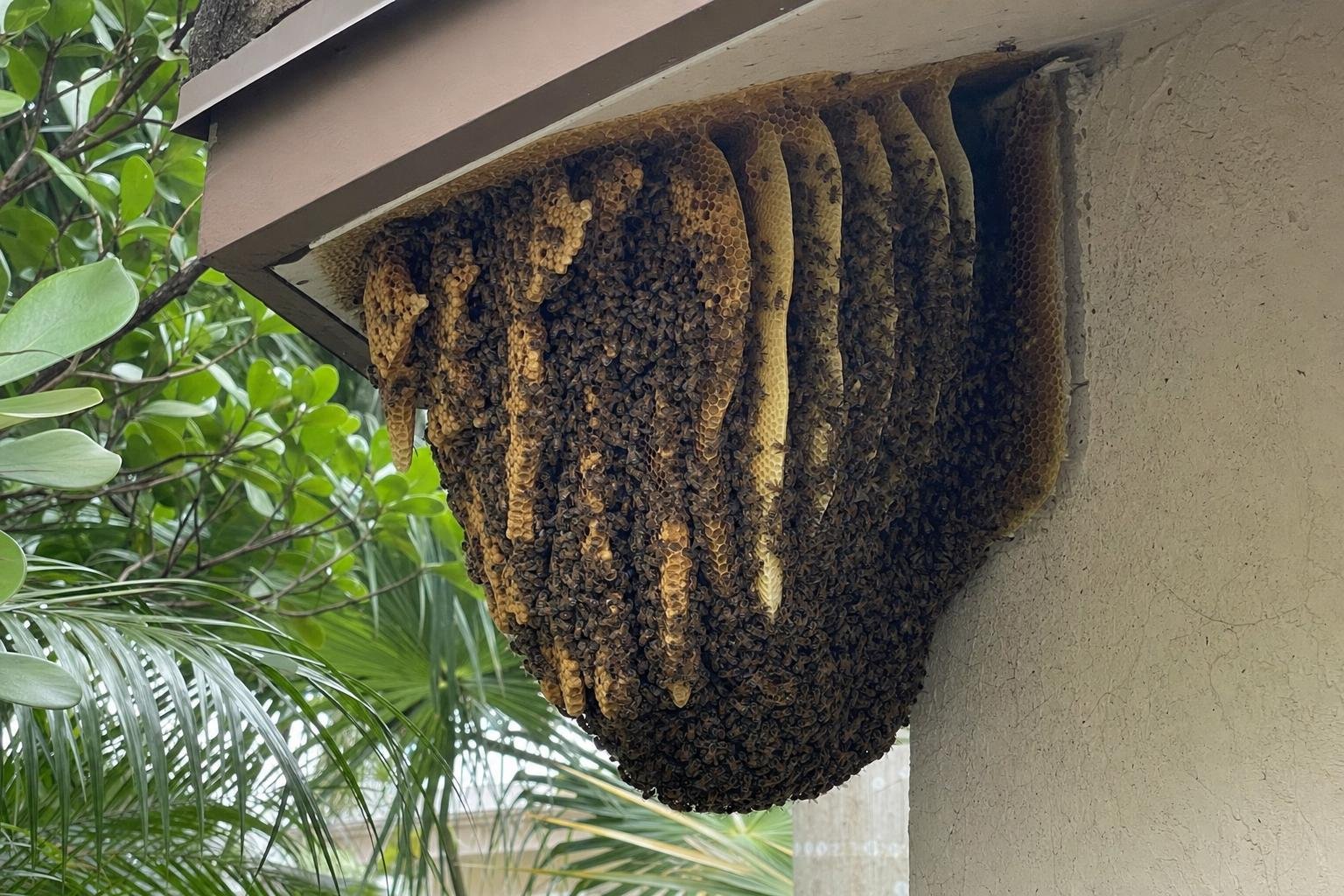
Humid, wet-season conditions
West Palm Beach summers are hot, wet and muggy, and the wet season is a long one. That affects this job more than people expect, because the wait can't be hurried. Standing outdoors for the better part of an hour in thick, humid air is part of the work, and so is watching the sky.
Rain is frequent here, and a downpour is a poor time to try a capture, so we'd rather talk with you about timing than force it. When the weather doesn't cooperate, it's the schedule that shifts, not the quality of the capture.
Price and what moves it
A hanging swarm capture runs $70 to $125 depending on how difficult the swarm is to retrieve. A cluster you can reach from the ground, with room to set the box underneath, sits toward the lower end. One that takes more reach, more careful positioning or more time with the vacuum costs more.
If it turns out to be a nest inside the structure rather than a swarm in the open, we'll tell you before any work begins.
How long it takes
This is a short visit, and most of it is the waiting period. Setting up beforehand and loading the closed box afterward are both quick.
We don't put a fixed number on the whole visit, because reach and weather both play a part. An easy-to-reach cluster on a dry afternoon makes for the shortest visit. A harder spot or a passing storm stretches it out.