
A ball of bees hanging from a palm frond, a fence, a car mirror or a balcony railing is usually a swarm. It's part of a colony that left its old nest and is resting while scout bees look for a new home. Most swarms move on by themselves. This guide covers keeping people safe in the meantime, spotting when a swarm is becoming a colony, and Florida's removal rules. Each point links to its state or University of Florida source.
Swarm or colony?
- A swarm hangs in the open, has no comb and is fairly calm, because it has no nest to defend yet. The Florida Department of Agriculture and Consumer Services (FDACS) says a swarm usually stays from a few hours to a few days.
- A colony has built comb and is storing honey and raising young. It will defend that nest.
- Signs that a colony has moved in: bees flying in and out of the same hole or gap, or a hum inside a wall, soffit or meter box. Palm Beach County Extension notes that bees turn protective once comb is built and the queen is laying.
The first hour: give it room
- Walk away and keep everyone back, children and pets especially. FDACS suggests teaching kids to find an adult whenever they spot a swarm or nest.
- Hold off on mowers, edgers, leaf blowers and other power equipment nearby. UF/IFAS says the vibration can stir bees up.
- Don't knock it down, spray it or try to kill it. FDACS strongly advises against removing or killing bees yourself. Besides the stings, it can bring pesticide-law trouble and liability if someone gets hurt.
- Don't plug a hole the bees are using. UF/IFAS warns that sealing an active entrance drives the bees deeper into the wall.
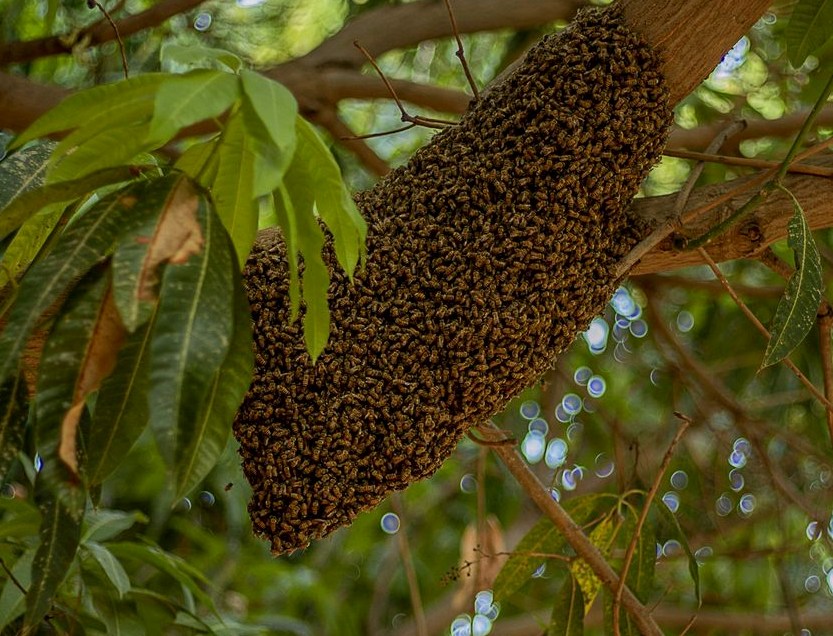
Will it leave on its own?
Often, yes. If it's still there after a few days, if you can see comb, or if bees are going in and out of a gap, it's settling in. FDACS and UF/IFAS recommend removing wild colonies that nest near places people or animals use. Whether the bees are removed, and how, is the property owner's call.
Swarm season in Palm Beach County
UF/IFAS puts Florida's main swarming season at roughly March through July, and says swarms come later in the year in South Florida. Palm Beach County Extension adds that Africanized honey bees swarm year round here. FDACS tells residents to watch for swarm traffic in spring, summer and fall. Plan for a swarm in any month.
About Africanized honey bees
- Florida confirmed its first Africanized honey bee in the Tampa Bay area in 2002. UF/IFAS now describes them as established in southern Florida.
- Nobody can tell them from European honey bees by looking. FDACS says it takes genetic testing.
- They defend a nest with less provocation, in larger numbers and over longer distances. A single sting carries no more venom than a European bee's.
- UF/IFAS says African colonies may swarm more than 10 times a year, against one to three for European colonies. They also nest in small spaces such as water meter boxes, cement blocks, old tires and grills.
- UF/IFAS tells consumers that a pest control company shouldn't claim your bees are Africanized or charge more because of it.
Treat every swarm and every colony with the same caution.
If bees start chasing you
- Run in a straight line, and cover your face, especially your nose and mouth.
- Get inside a car or building. FDACS notes that bees which follow you in tend to fly to the windows.
- Don't stop to swat. UF/IFAS also says not to jump into water or hide in bushes.
- Scrape stingers out with a fingernail or the edge of a card, because squeezing pushes in more venom. Then wash with soap and water and use an ice pack.
- Get medical help right away if breathing is affected, after many stings, or for anyone allergic to bee stings. For sting questions, FDACS points people to Florida Poison Control.
Who Florida allows to remove bees
- Live removal. A registered Florida beekeeper may remove a swarm or colony and move it to an apiary under Rule 5E-14.151, F.A.C. That takes an FDACS beekeeper registration, not a pest control license.
- Eradication. Killing a colony counts as pest control, and only a licensed pest control company may do it (s. 482.021, F.S.).
- Your choice. No Florida law makes beekeepers save bees or makes pest control companies kill them. FDACS notes that eradication is often the safest choice when a colony is a stinging threat, can't be removed safely, or isn't likely to survive.
- Repairs. UF/IFAS says a licensed contractor should handle structural repair of an opened wall or soffit.
How to check who you hire
FDACS publishes a list of registered beekeepers and pest control operators who do this work, searchable by county. It's a reference, not an endorsement. Before work starts, ask:
- for the beekeeper registration number or the pest control license number, which FDACS says is required. For a pest control company, UF/IFAS points to a General Household Pest or Lawn & Ornamental license.
- about liability insurance.
- how the comb and honey will come out. Leftover comb can ferment, stain walls and attract roaches.
- where the bees will go, and who repairs any opening.
- on a daytime job, how they'll handle the foragers that come back that evening.
UF/IFAS suggests a written contract that covers the method and the full comb removal. Without one, a customer may have no recourse.
For condo and HOA boards
- Decide who decides. UF/IFAS notes that the property owner or an authorized agent chooses the method, and that some associations and cities have their own removal rules. Check your governing documents and name who can approve a job.
- Write a one-page plan. FDACS encourages a safety plan and talking with neighbors. Cover where residents report a swarm, that nobody sprays or disturbs it, who approves a removal, and a link to the FDACS list.
- Bee-proof the common areas. Look for gaps of 1/8 inch or more around meter boxes, downspouts, vents, eaves, pipes and cracked block. Screen vents and drains with 1/8-inch hardware cloth and caulk cracks, but never seal an opening bees are using. UF/IFAS suggests weekly checks during swarm season.
- Finish the job after a removal. Palm Beach County Extension notes that bees return to where wax and honey used to be. Have the cavity cleaned out and closed promptly.
- A neighbor's hives are a state matter. Every Florida beekeeper must register with FDACS and mark each hive with their registration number. State law gives FDACS authority over managed colonies and overrides related city and county ordinances. Questions about someone's hives go to the local FDACS apiary inspector.
Official sources
- FDACS: Honey Bee Removal or Eradication in Florida, with the removal list
- FDACS: Africanized Honey Bee FAQ
- UF/IFAS: Bee-Proofing for Florida Citizens
- UF/IFAS: Choosing the Right Pest Control Operator for Honey Bee Removal
- UF/IFAS Extension Palm Beach County: Bee Cautious and Bee Proactive!
If the swarm has stayed put, or bees are going into a wall, soffit, meter box or tree, request a free quote.
Other Services We Offer
Straight Answers
A two-minute call is all it takes, and you decide what happens next.
Updated October 2026